The Marbella that international buyers know today did not exist in 1954. What existed then was a fishing village of some six thousand people, a narrow coast road, and a young Austro-Bavarian aristocrat named Alfonso von Hohenlohe-Langenburg who had just bought a beach-front finca for the price of a Madrid apartment. What he built on it — the Marbella Club Hotel — began the seven decades of a place that is now one of the most concentrated addresses for the internationally wealthy in Europe.
Understanding this history matters when you are considering a home here. Not because the celebrity register is a substitute for due diligence — it is not. But because why the same coastline has held generation after generation of the internationally wealthy tells you something durable about the market you are entering.
1954–1970: the founding generation
Hohenlohe opened the Marbella Club Hotel in 1954 with a specific proposition: that Andalusia's climate, discretion and social freedom made it a natural counterweight to the more publicly observed resorts of the Côte d'Azur. His personal network — European nobility, industrialists, film producers — made the venture. Within a decade the guest list included Audrey Hepburn, the Rothschilds, the Bismarcks, Ava Gardner, Aristotle Onassis, and the young King Baudouin of Belgium.
The physical shape of Marbella today still reflects that generation's tastes. Low-rise, whitewashed, terracotta-roofed; landscaping over signage; entrances tucked behind bougainvillea rather than opening onto a street. This is not aesthetic conservatism — it is the codified preference of the people who set the rules of the place, and it is the reason planning permission on the Marbella coast has been, and remains, strict.
1970–1990: the Gulf era
The second wave came from further east. King Fahd of Saudi Arabia bought his first Marbella palace in the 1970s and expanded through the 1980s into the compound now known as Mar Mar, a Casa Blanca-style complex to the west of the Old Town that houses hundreds of retinue members during his family's summer visits. The Saudi royal presence was — and remains — the largest single Gulf-family footprint on the coast. Members of the ruling families of Qatar, the UAE, Bahrain and Kuwait have followed.
The Gulf era shaped the coast in ways that are still visible. The scale of some estates on the Golden Mile — the six-kilometre stretch immediately east of Puerto Banús — dates from this period. So does the diversification of local infrastructure: private aviation at Málaga, halal fine dining, discreet clinic wings, twenty-four-hour concierge networks. These were not built for tourists. They were built because Marbella committed to being the summer capital of a very specific clientele, and it delivered.
1990–2010: sport, entertainment, business
Puerto Banús opened in 1970 as a project of the property developer José Banús and quickly became the retail arm of the new Marbella. By the 1990s it was drawing a different cohort: footballers, tennis players, entertainers, self-made industrialists. Antonio Banderas — born just up the coast in Málaga — kept his primary Andalusian residence in the Marbella area throughout his Hollywood decades and continues to be a public presence, notably through his restaurants and his Málaga theatre project.
The tennis history of the coast deserves its own footnote. Puente Romano Beach Resort has hosted an ATP tournament and served as a training base for touring professionals since the 1980s; Novak Djoković, Rafael Nadal and others have used the site during their off-seasons. The Real Club de Golf Sotogrande — thirty minutes down the coast — and the Marbella Golf Club circuit have kept a permanent international golf population here since the 1970s.
2010–today: the discreet capital
What has changed in the last fifteen years is less about who arrives and more about how they arrive. Puerto Banús is still visible and still loud; the Golden Mile, San Pedro de Alcántara and the newer developments in Benahavís and La Zagaleta are the opposite. The trend is towards quieter, gated, architecturally serious homes occupied by people whose names are known but whose Marbella lives are not.
Publicly documented recent owners and long-term residents in the wider Marbella corridor include Eva Longoria (who has spoken openly about her property here and its role in raising her son with local roots), the pop artist Julio Iglesias (a decades-long Ojén and Marbella presence), the tennis player Novak Djoković (training base), and members of European industrial families whose discretion earns them mention only in specialist press. Cristiano Ronaldo has been reported to hold property in La Finca de Marbella; the Beckhams have been recurring seasonal residents.
None of these names sells a house. What they signal is different. They signal that the coast has held its position through six changes of Spanish government, two Eurozone crises, a pandemic, and the shift to remote work. That is a durability statement, and durability is what serious buyers pay for.
Why San Pedro de Alcántara, specifically
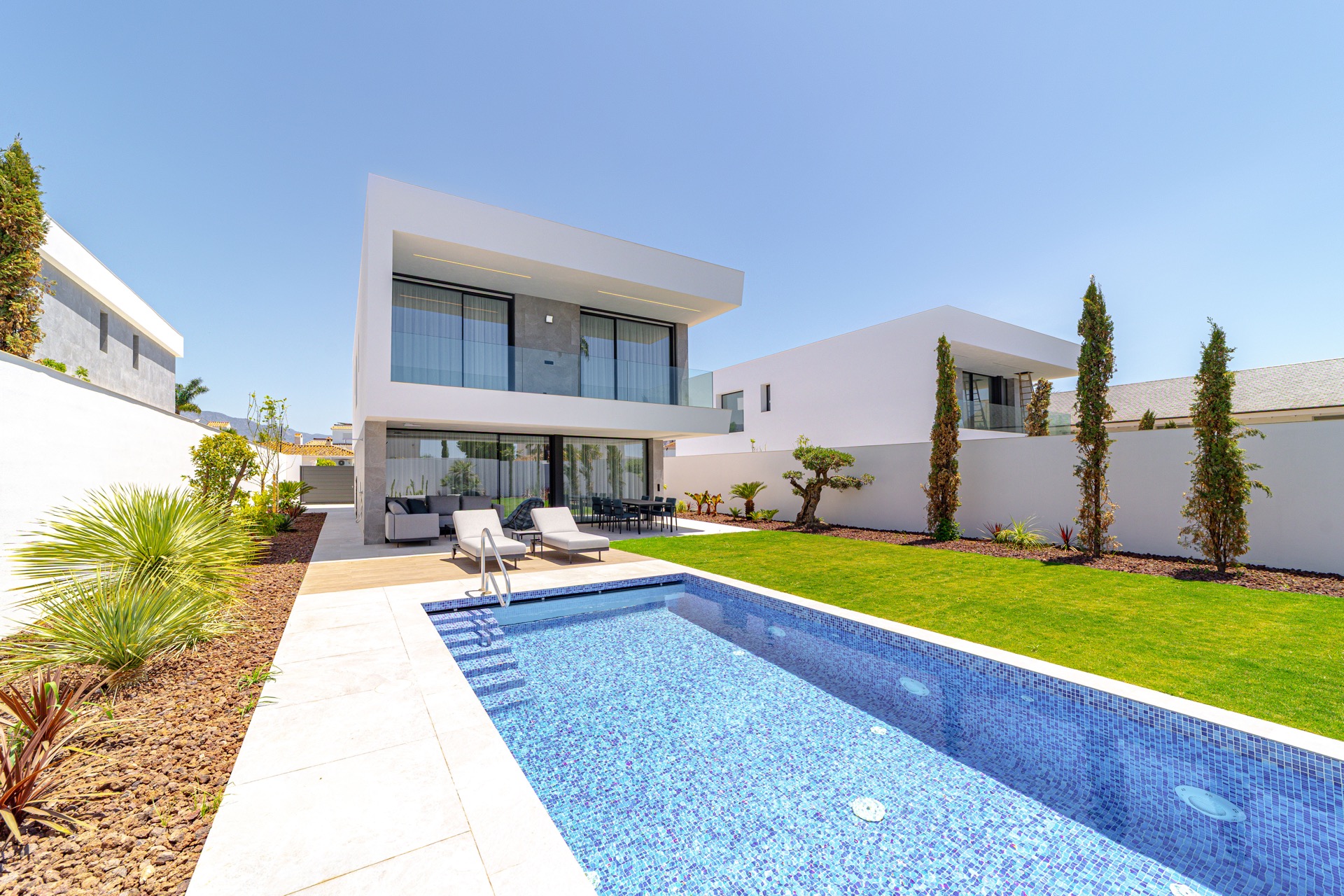
The three villas at Linda Vista Playa sit in the beach-side urbanisation of San Pedro de Alcántara — the residential neighbour of Marbella and Puerto Banús. San Pedro is the quiet cousin of the Marbella brand: family-oriented, walkable, with a renovated town centre, a long beach promenade and a cluster of international schools (Laude, Swans, Aloha, Atalaya). It is the address for buyers who want the Marbella corridor's infrastructure but do not want to live inside the Puerto Banús theatre.
Beach-side plots in San Pedro — inside an established urbanisation, 450 metres from the Mediterranean, on a cul-de-sac — reach the market rarely. The coastline does not expand. The planning code holds. The people who buy here now are typically buying the last available seat in a room that has been held by the same kind of tenant for seventy years. That is the tradition Linda Vista Playa quietly belongs to.
What you are buying is not the celebrity next door. What you are buying is the discipline of a coastline that has said no to the wrong developments for seven decades — and yes to the right ones.
Tereza Šimák is the real estate and finance consultant for Linda Vista Playa. Private viewings, financing and end-to-end transaction support for international buyers are arranged individually. Reach her on WhatsApp +420 734 300 733 or by email.